
Vibe Coding won’t replace developers — but it will replace those who don’t use it
I’ve been developing websites since 1995. HTML tables, the first experiments with CSS, PHP, WooCommerce, REST APIs — I’ve witnessed the entire evolution of the web. And to be honest, over the last 30 years, few things have fascinated me as much as what’s currently happening in AI-powered development.
A few months ago, I decided to put it to the test properly. Not just to generate a few code snippets — but to take it from the initial idea right through to a finished, commercial product. To put Vibe Coding to the test.
Here’s what I’ve learnt.
The idea: solving my own problem
As a trainee trader, I needed a journal to document and analyse my trades. Exporting everything manually from the broker’s app to Excel was too fiddly and time-consuming.
So I asked Claude if he could help me out: extracting data, a simple form, a few notes. Ten minutes later, I had an overview with a filter function, real-time import from cTrader and a clean admin interface. And it looked great.
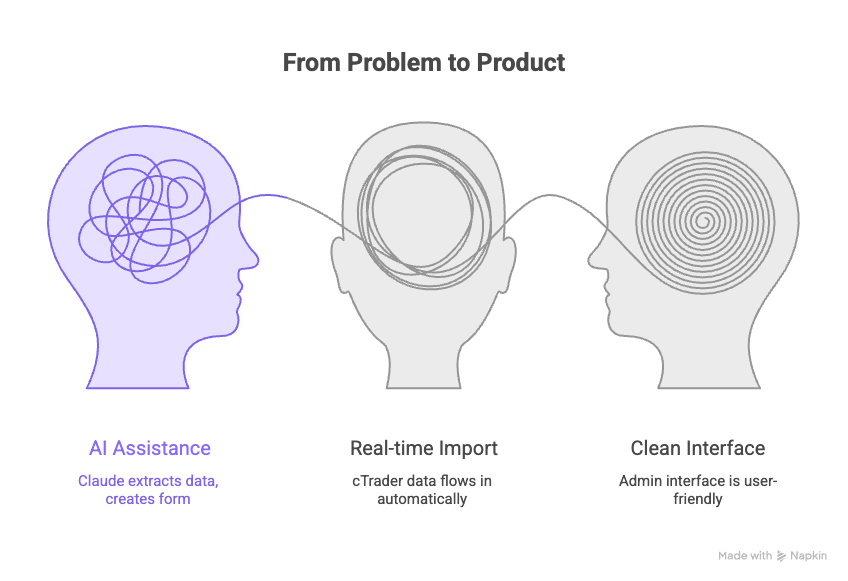
That’s when the idea struck: why not turn it into a commercial product?
Don’t just start coding — think first
Thanks to my experience in product development, I knew that before a single line of code is written, the foundations must be right.
So I started by conducting market research with Claude. We analysed existing products, examined their strengths and weaknesses, and compared business models. On that basis, we worked together to define what an MVP needs to deliver — and what it doesn’t.
That was one of the most important moments of the whole project. Not the code itself, but the clarity that came before it.
From idea to product in just a few days
With a clear scope and thorough preparation, the implementation went surprisingly quickly. I started in the browser, but soon realised that this was too restrictive. Switching to Claude Code in the terminal was the right move — with the memory function and project files, Claude could be guided towards a goal much more reliably.
Within a few days, we had a product featuring a subscription system, a client dashboard and cTrader synchronisation. A product that offers real added value for traders and can hold its own against the competition.
The reality check: where Vibe Coding hits its limits
Now for the honest part.
Claude often just jumped straight in before the task had been fully defined. This led to exactly what many of us are familiar with: a bug here, a bug there — and suddenly the first bug has reappeared. Add to that the AI’s false sense of confidence: ‘I’ve found the problem and the solution!’ — and then it turned out not to be the solution after all.
Forgotten change logs. Git repository not up to date. Architectural decisions that worked in the short term but caused problems in the long run.
Things improved significantly once I’d set clear rules and started working in short sprints. Breaking tasks down into small chunks, completing each step properly before moving on to the next. Classic project management — applied to an AI developer.
What I’ve really learnt
Vibe Coding isn’t an autopilot. It’s a powerful tool — but one that needs to be guided.
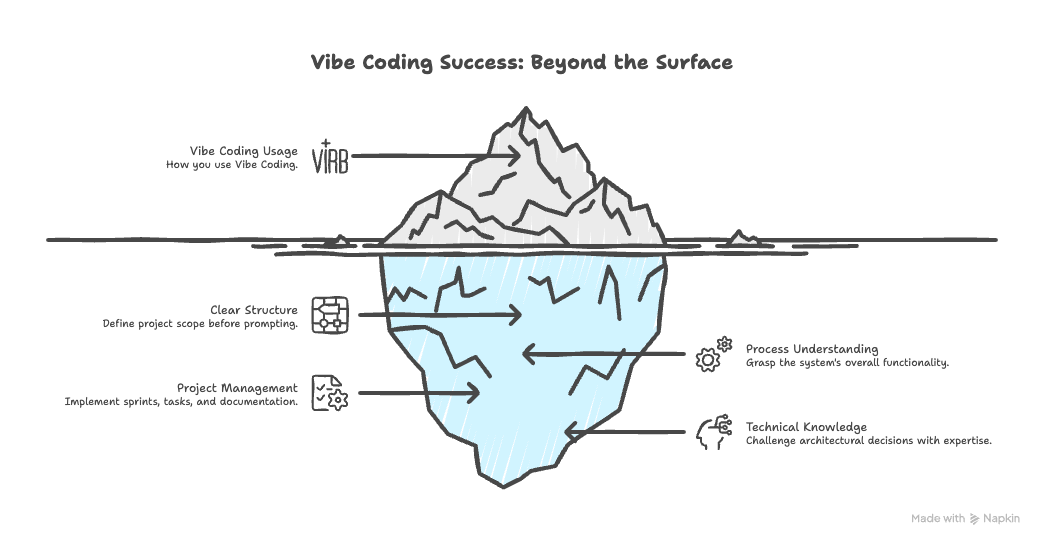
What makes the difference isn’t whether you use Vibe Coding. It’s how you use it:
A clear structure before the first prompt. What exactly needs to be built? What doesn’t? Anyone who doesn’t know this will pay dearly for it during implementation.
A genuine understanding of the process. You need to understand what the code does — not every single line, but the system as a whole. Otherwise, you won’t realise when Claude is heading in the wrong direction.
Project management isn’t optional. Short sprints, clear tasks, thorough documentation. It may sound boring, but it saves the project.
Technical knowledge pays off. I was able to challenge Claude’s architectural decisions because I know how systems work. Without that knowledge, I would have simply rubber-stamped a lot of things — and paid the price later.
Conclusion
Vibe Coding won’t replace developers. But it will replace those developers who don’t make use of this tool.
The good news is that anyone who already knows how to structure projects, define requirements and scrutinise technical decisions has a huge head start. AI gives us the speed. Craftsmanship gives us the quality.
I still build websites for companies — just faster than I used to.
Marcel Heiniger ist Webentwickler aus Ipsach bei Biel und entwickelt seit 1995 Websites.
Er hilft KMUs mit massgeschneiderten WordPress- und WooCommerce-Lösungen.