
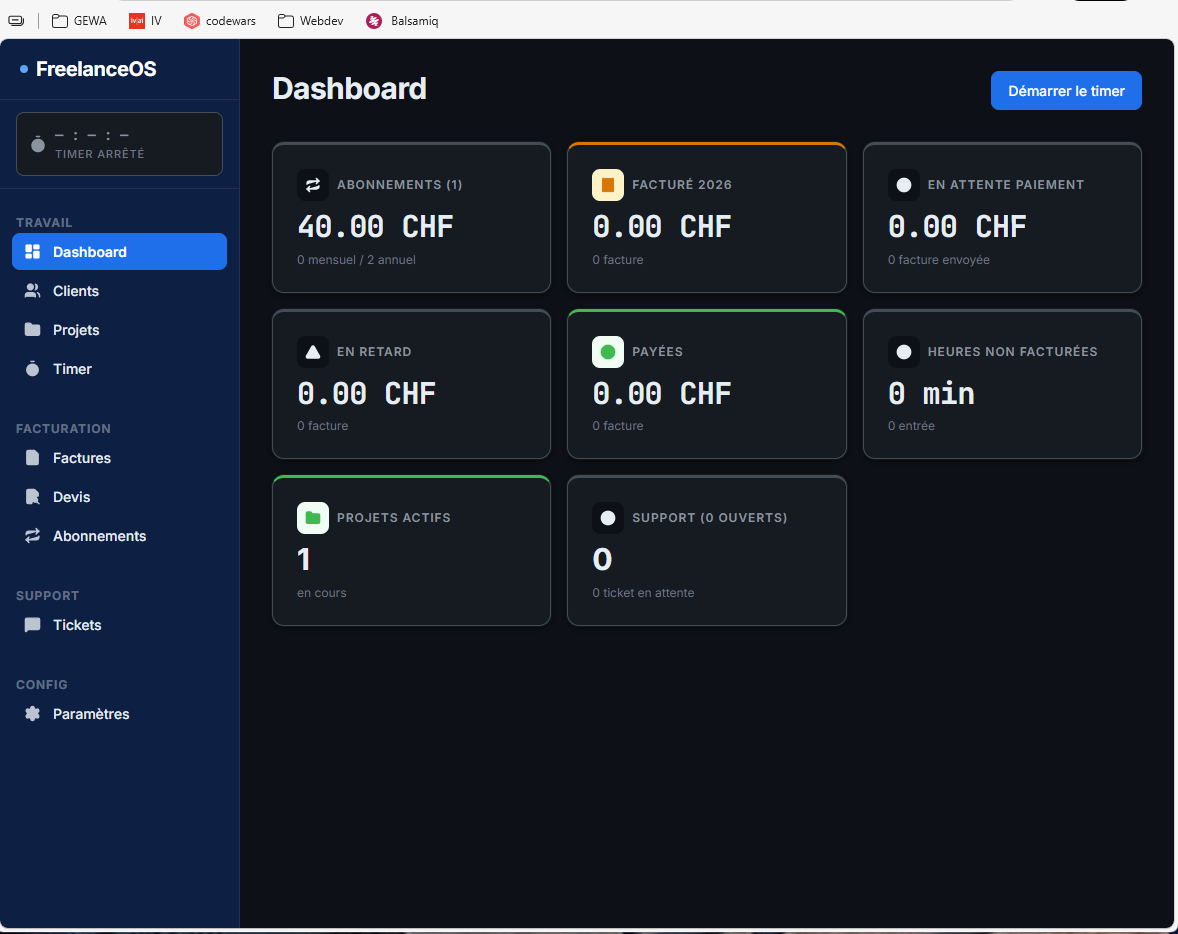
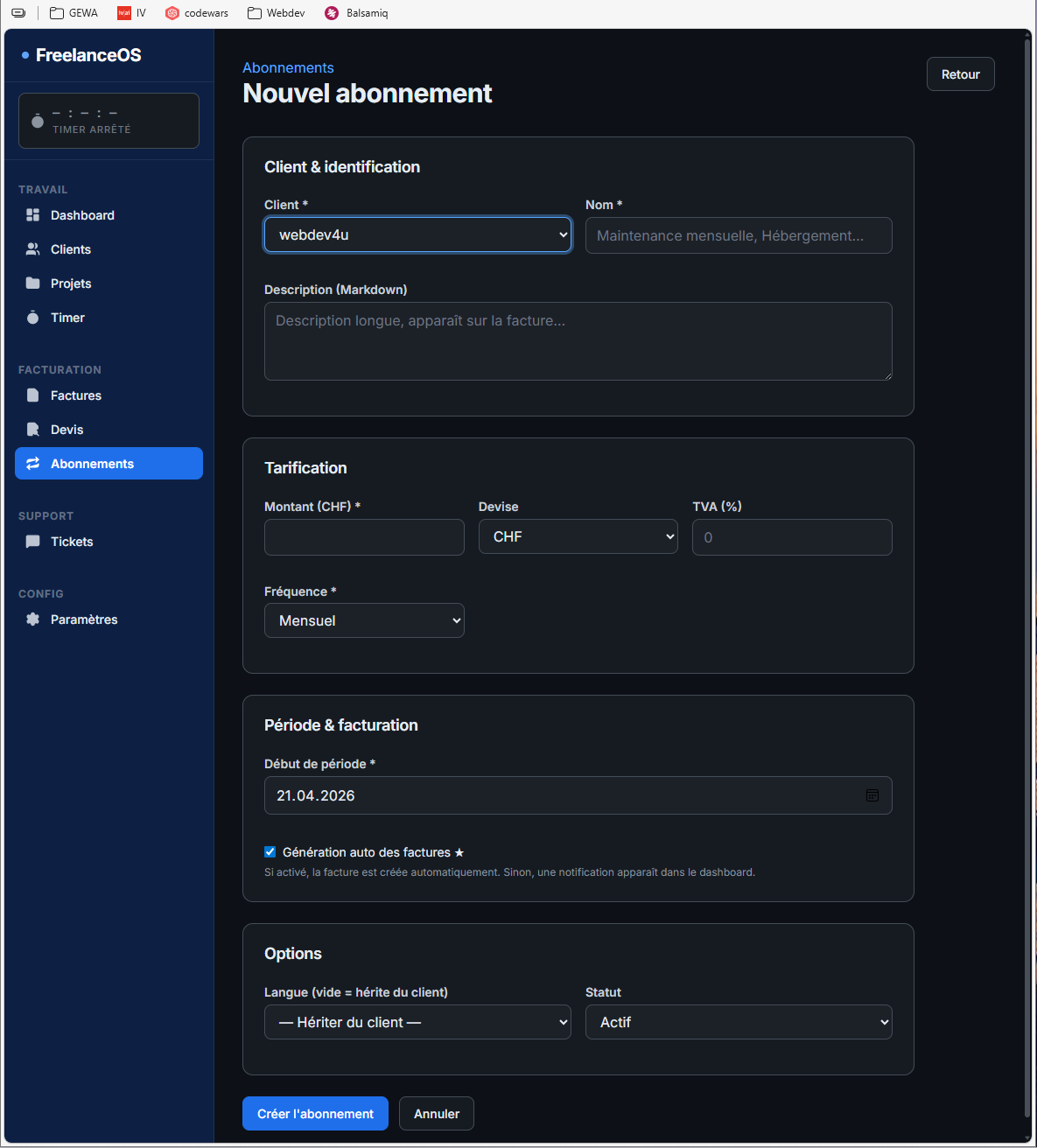
Freelance OS

As a freelancer, you have to juggle several tools every day: client data in Excel, quotes in Word, invoices in another tool, and time tracking in your calendar.

Challenge

As a freelancer, we juggle multiple tools every day: client data in Excel, quotes in Word, invoices in yet another tool, time management in a calendar, and support requests in our inbox. It takes time, leads to mistakes, and isn’t scalable. I needed a single system that covers all my business processes — and works exactly the way I work.

So I created it myself.

Solution

Freelance OS

A CRM and business management system developed entirely by me, tailored to the reality of a Swiss freelancer. No compromises with off-the-shelf software, no monthly fees for features I don’t need.

Features:

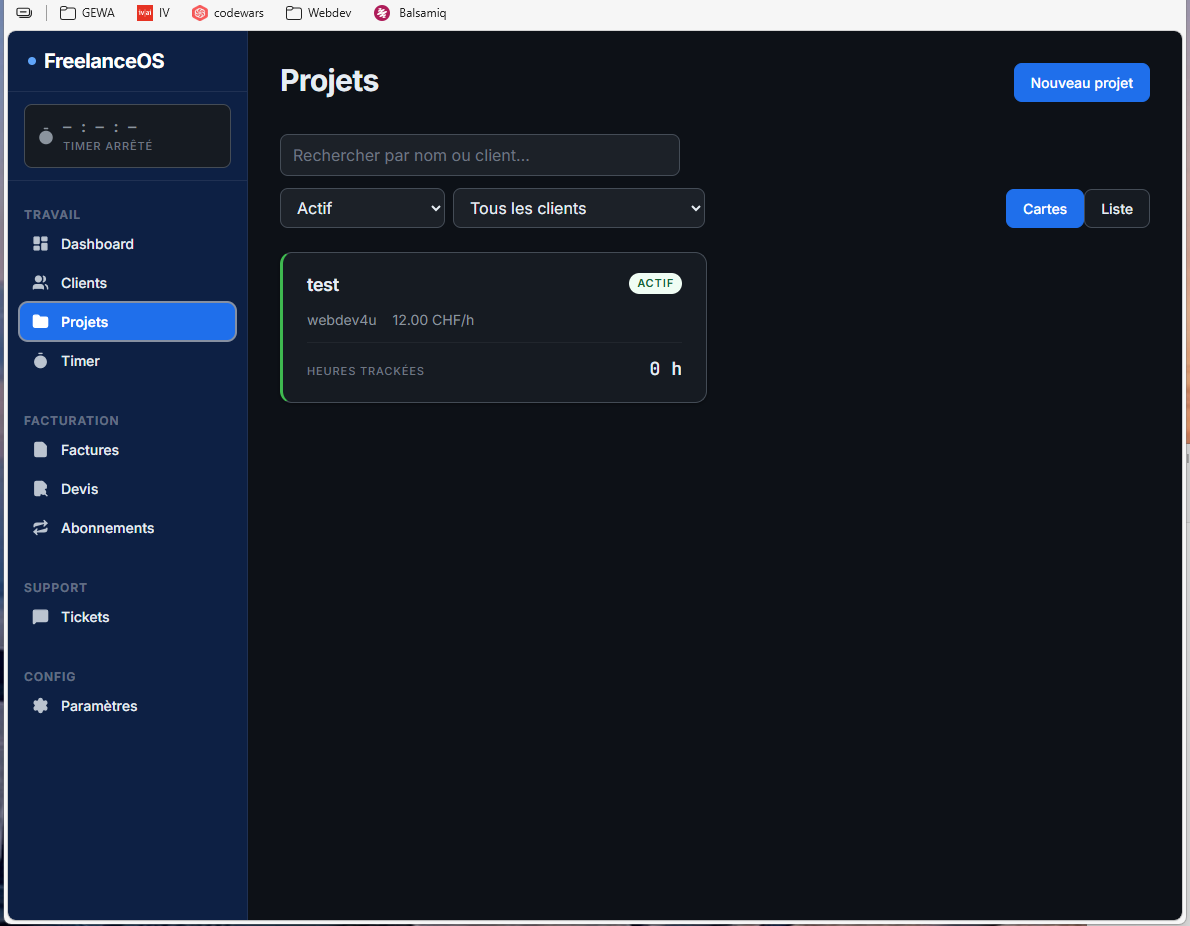
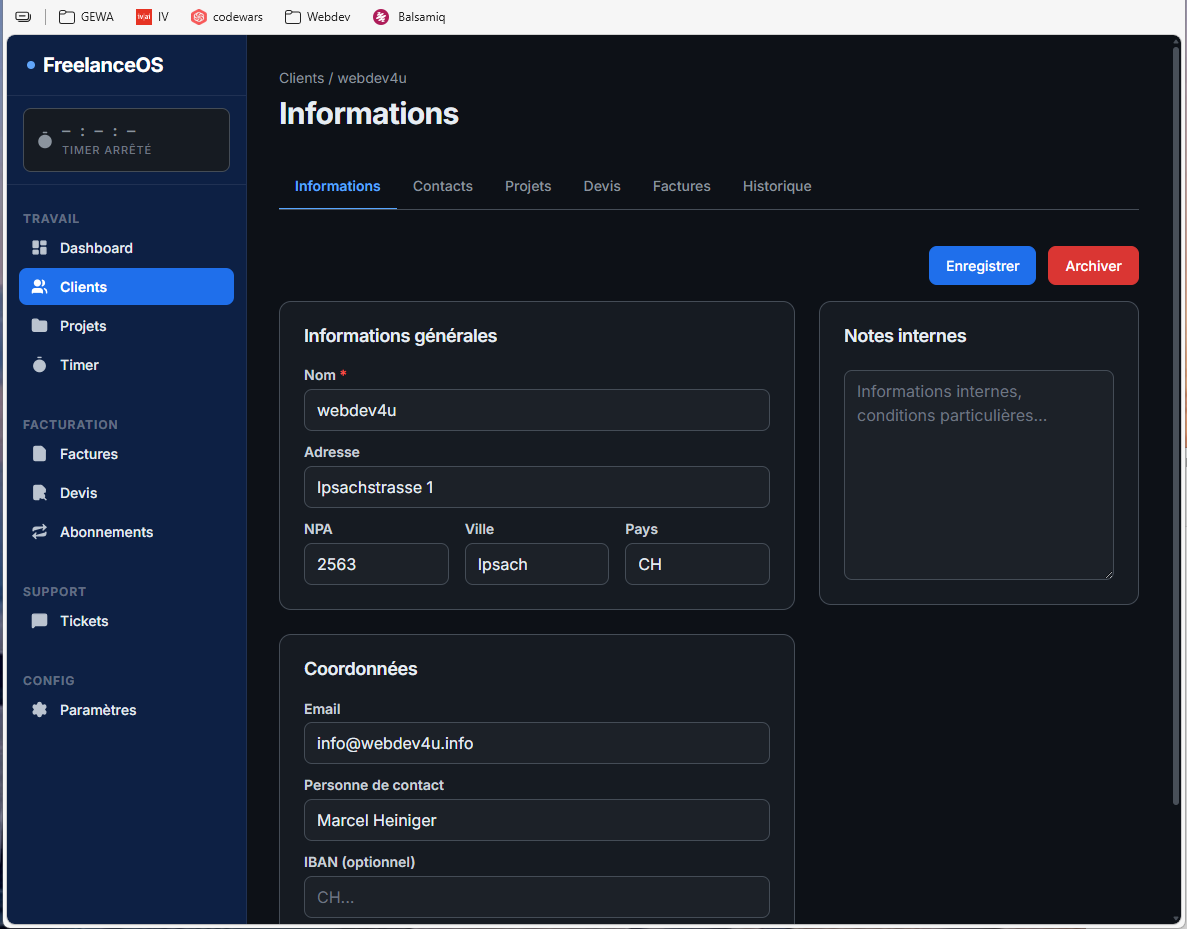
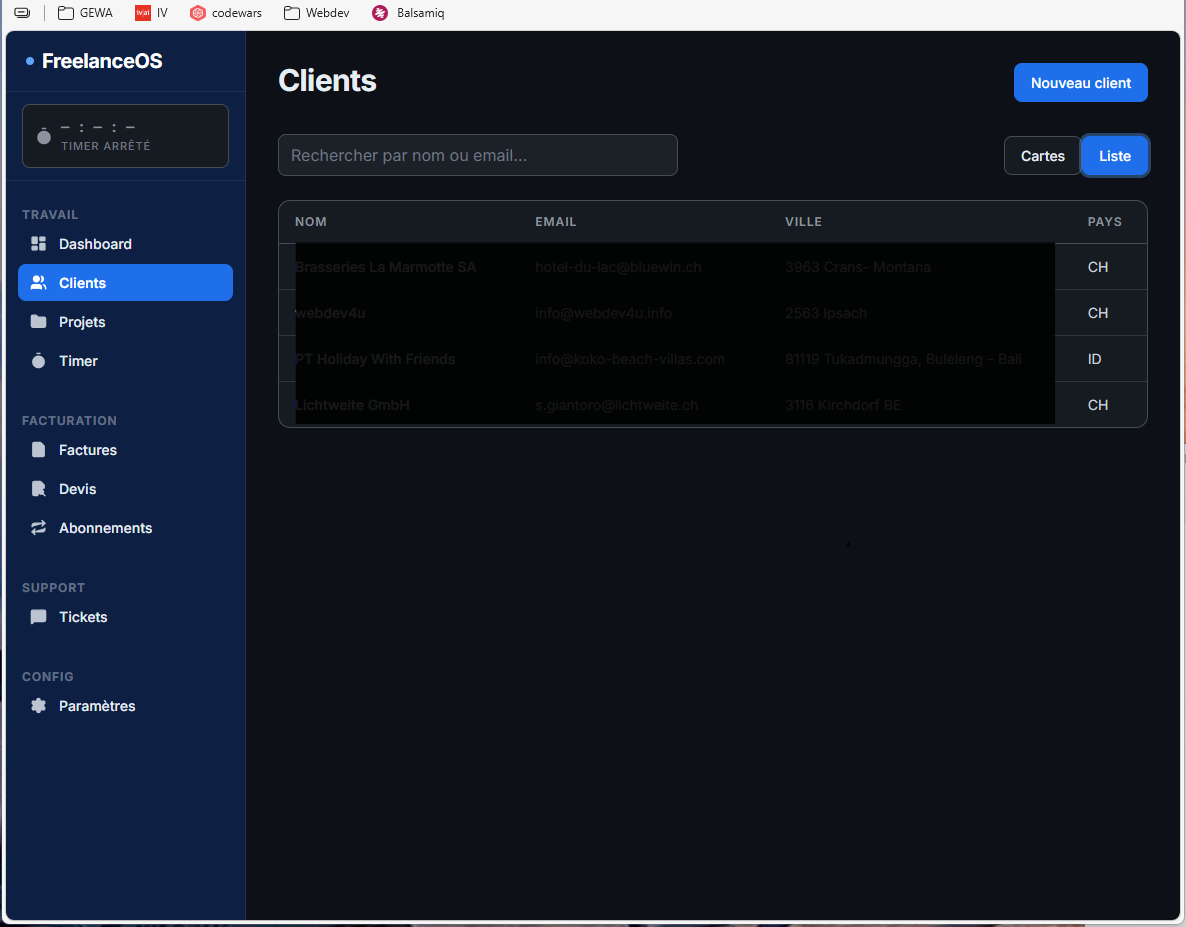
  • Client management: central database with contacts, projects, notes and document history. Full-text search and filters.
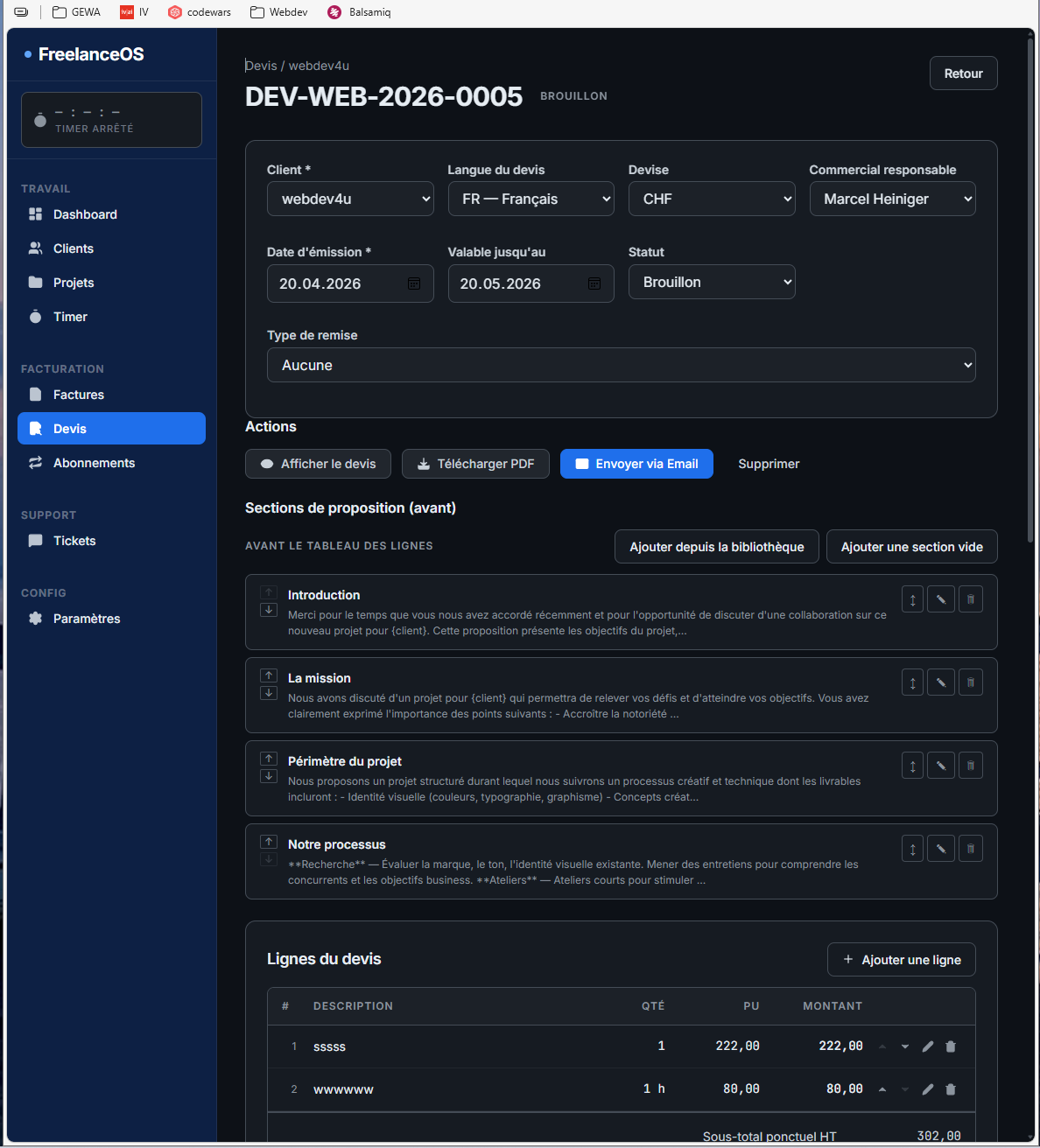
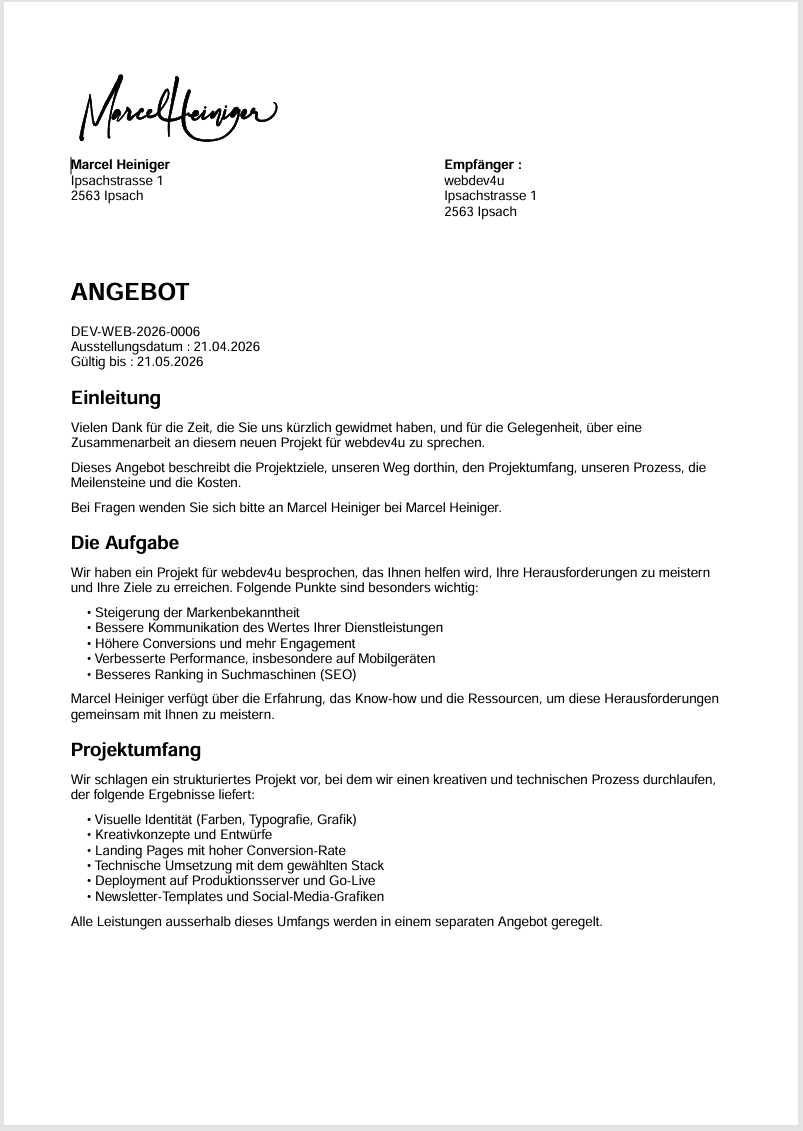
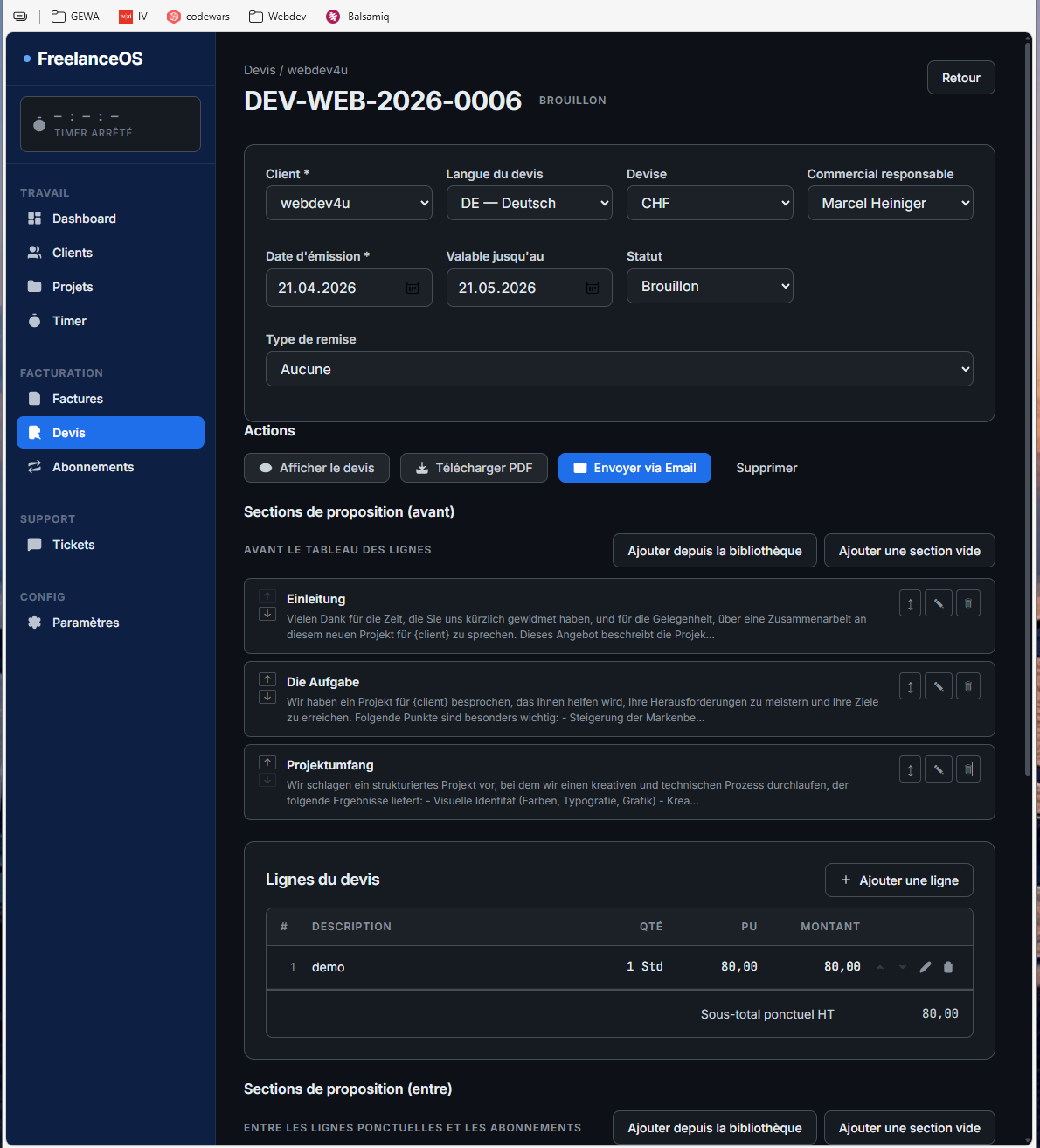
  • Quotation creation: template-based quotation system with line items, discounts and automatic numbering. Direct sending as a PDF via email.
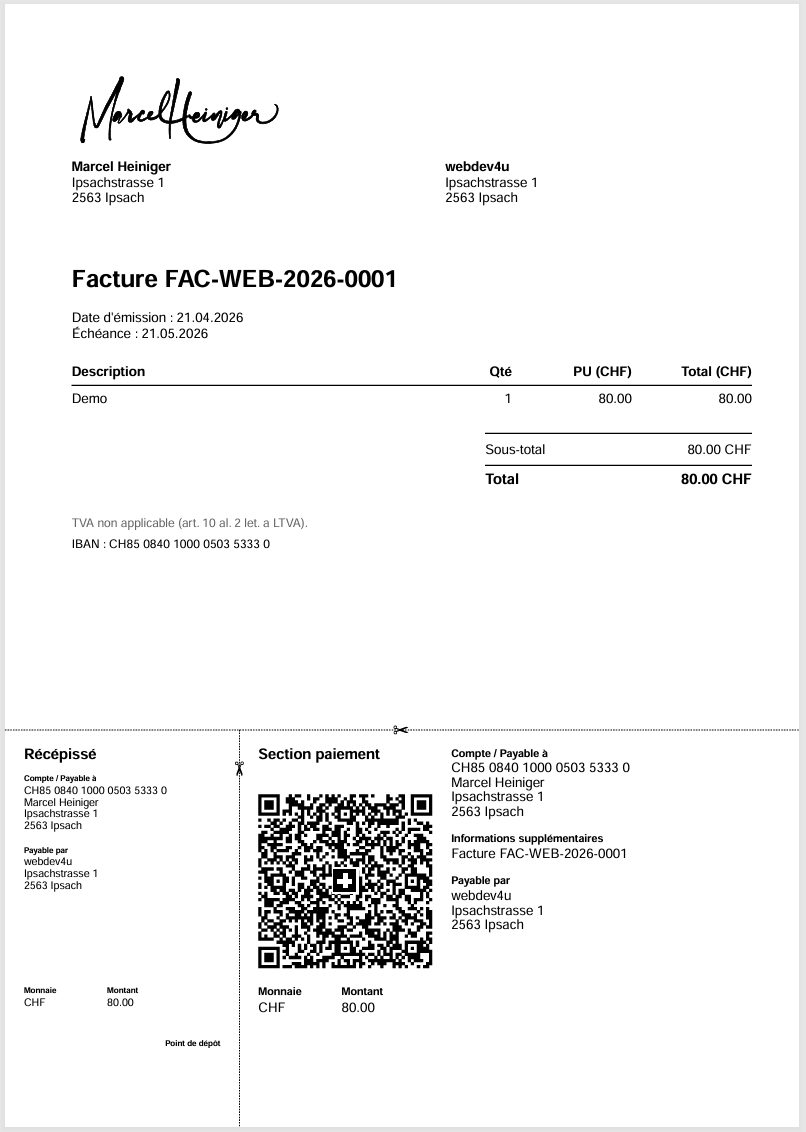
  • Invoicing with Swiss QR codes: QR invoices fully compliant with the Swiss ISO 20022 standard. Automatic generation of the QR code, including IBAN, reference number and payment details.
  • Subscription management: recurring invoices for maintenance contracts and hosting packages. Automatic invoicing at defined intervals (monthly, quarterly, annually).
  • Support tracking: ticketing system for customer requests with status, priority and time allocation. Each hour of support is automatically allocated to the correct customer and project.
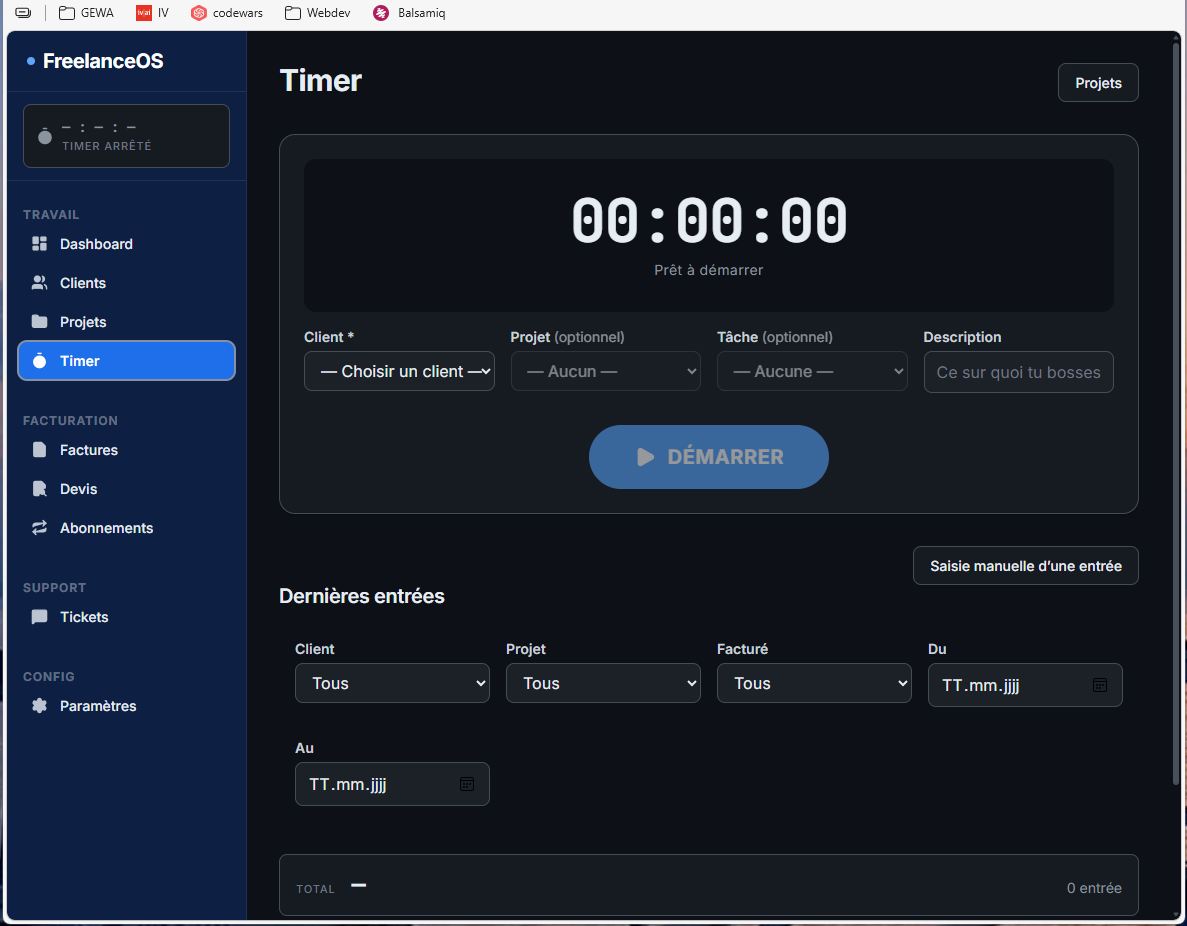
  • Time tracking: integrated time entry with start/stop function. Time entries can be directly transferred to quotes and invoices.
  • Dashboard and reports: overview of pending invoices, ongoing projects, recorded hours and revenue trends.

Results

Why this project is important: Freelance OS is much more than just an internal tool: it demonstrates what can be achieved by combining business logic, data modelling, Swiss payment standards and sleek user interface design. No off-the-shelf plugins, no third-party SaaS: everything has been developed in-house, tested and is used daily in production.

Project Highlights

  • Swiss QR invoice with the three reference methods

    QR invoices that are fully compliant with the Swiss ISO 20022 standard.

    Unique technical feature

    Most invoicing tools in Switzerland only support one variant of the QR invoice — usually the simplest one. Freelance OS implements all three official modes in accordance with the Swiss QR-Bill standard. This means that freelancers and businesses can choose exactly the mode that suits their bank, their accounting system and their workflow.

    Three modes, one solution

    QRR — 27-digit reference (standard QR reference)

    • Requires a QR-IBAN (assigned by your bank, starting with CH…)
    • Structured 27-digit reference number per invoice
    • Enables automatic matching of incoming payments with pending invoices
    • Ideal for businesses with a high volume of invoices

    SCOR — Creditor reference (RF…)

    • Uses the standard IBAN (no need for a separate QR-IBAN)
    • Reference compliant with ISO 11649 (international standard, RF… format)
    • Automatic reconciliation possible depending on the bank
    • Useful for SMEs that do not wish to set up an additional QR-IBAN

    NO — No reference

    • Standard IBAN, no structured reference
    • The invoice number appears in the ‘Additional information’ field
    • Manual reconciliation in the accounts
    • Suitable for sole traders who have few invoices per month

    Why it matters

    For a freelancer or SME, choosing the wrong mode often means extra manual work in accounts receivable. Freelance OS doesn’t make this decision for you — it lets you make an informed choice, thanks to clear explanations directly in the user interface:

    “QR-Bill mode — Choose how your Swiss QR-Bill invoices will be issued. This choice determines whether a structured reference is generated and which IBAN is used.”

    This demonstrates not only a technical understanding of the ISO 20022 specification and the SIX QR-Bill regulations, but also an understanding of the underlying business process — from invoice creation to the automated posting of incoming payments.

    Technical implementation

    • Validation of the IBAN format and type (standard IBAN vs QR-IBAN)
    • Correct calculation of the check digit using the recursive modulo 10 (QRR) and modulo 97-10 (SCOR)
    • Generation of clean PDFs with a standards-compliant QR code (2021 version, ‘QR-Rechnung’ style)
    • Dynamic form logic: depending on the selected mode, fields are displayed or hidden

    What this means for a client

    If we are able to correctly implement complex Swiss financial standards — including all special cases and validations — we can also accurately replicate your individual business logic in software. Whether it’s an ERP connection, a POS system integration or automated dunning processes.

  • The 10-point bidding system

    Much more than just a PDF generator A standard quote is often nothing more than a simple price list on letterhead. However, it is professional quotes that make the difference, not the prices. That is why I have developed a 10-point structured quoting system within Freelance OS, which systematically covers every aspect of a compelling quote.

    Much more than just a PDF generator

    A standard quote is often nothing more than a simple price list with a header. But it’s the professional quotes that make the difference, not the prices. That’s why I’ve developed a 10-point quote system in Freelance OS that systematically covers every aspect of a compelling quote.

    The 10 elements

    1. Intro — Personalised introduction based on the initial consultation
    2. Letter — Summary of the client’s situation in your own words
    3. Scope — Clear definition: what is included, what is not
    4. Process — Outline of the collaboration with defined phases
    5. Timeline — Milestones and binding deadlines
    6. Credibility — References and relevant experience
    7. CTA — Clear call to action with next steps
    8. Legal — Terms and conditions, validity, payment terms
    9. Subscription — Recurring services for long-term support
    10. Pricing — Items, discounts, total amount including VAT

    The order has been chosen deliberately: first the relationship and clarity, then trust, and finally the price.

    Technical implementation

    • Reusable text blocks and templates for each section
    • Automatic filling of client and project data
    • Automatic numbering and version management
    • Export to PDF format in line with the brand identity and direct sending via email
    • Status tracking: Draft → Sent → Accepted / Rejected

    What this demonstrates

    Anyone capable not only of developing such a system from a technical perspective, but also of thinking through its content, understands not only the code, but also sales and customer communication.